Get Your Free Quote…!


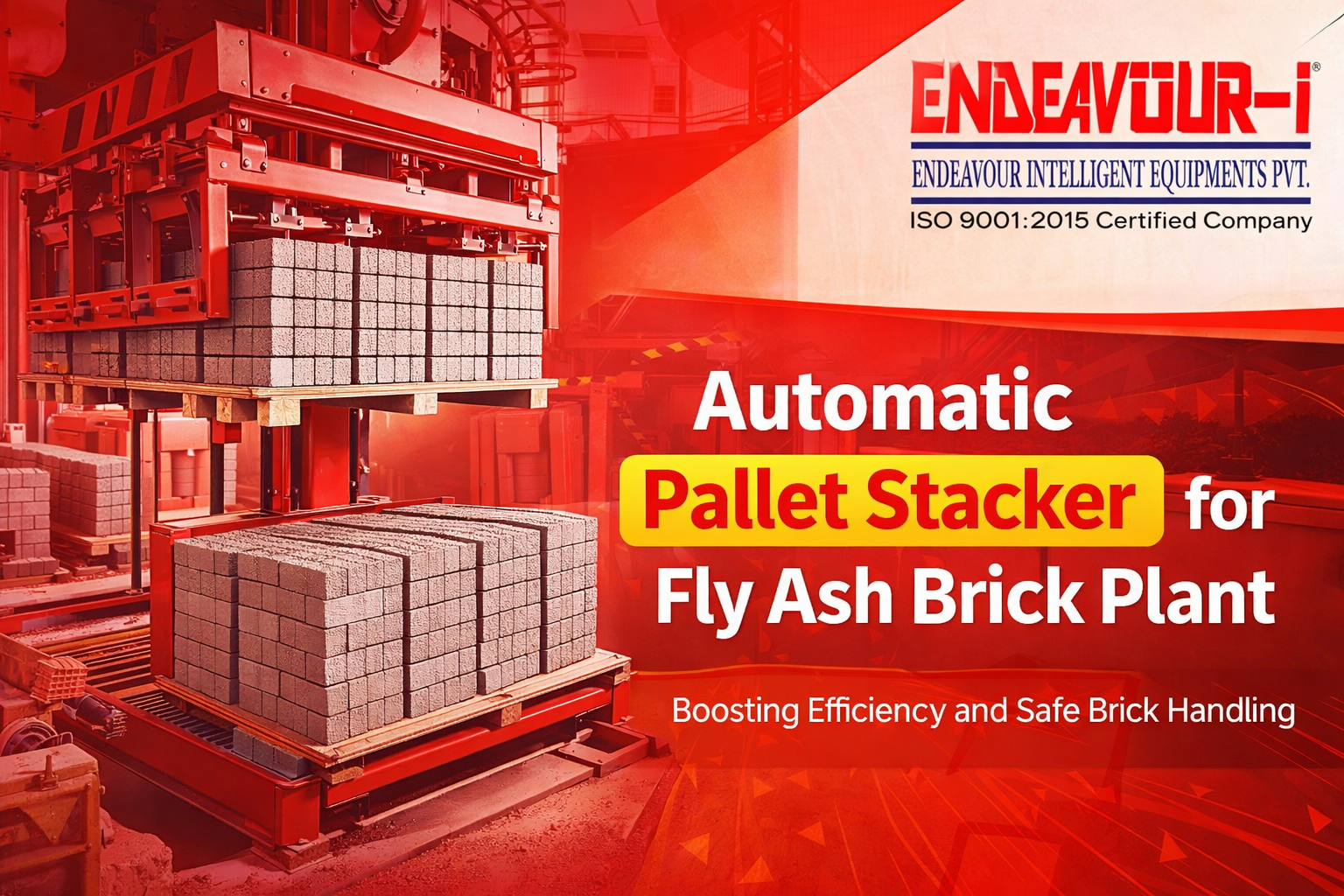
An automatic pallet stacker improves the flow of brick handling by organizing green or cured bricks into stable pallet stacks with controlled movement. In fly ash brick plants, this directly supports higher uptime, consistent dispatch readiness, and safer shop-floor operations.
Best suited for
Fully automatic fly ash brick plants
Primary goal
Reduce breakage and manual handling
Integration
Conveyor, cuber, curing yard workflow
Outcome
Stable pallet stacks for easy dispatch
An automatic pallet stacker is a mechanized system that collects fly ash bricks from a conveyor line and stacks them on pallets in a controlled sequence. It replaces manual stacking with sensor-based alignment, repeatable layer placement, and synchronized movement, helping a plant maintain steady production without stop-start interruptions.
In fly ash brick manufacturing, output is not only defined by bricks-per-hour but also by how smoothly bricks are handled after pressing. Poor stacking causes chipping, uneven load distribution, and rework during dispatch. Automatic stacking creates predictable stacks that are safer to move and easier to store.
Common plant issues solved
The pallet stacker operates through a controlled sequence. Bricks travel from the production line to the stacking zone, where sensors detect position and quantity. A PLC-based control system coordinates actuators to form layers, place separators if required, and stack layers on a pallet with consistent spacing and alignment.
| Stage | What happens | Why it helps |
|---|---|---|
| Infeed | Bricks arrive from conveyor with controlled spacing | Prevents collisions and edge marks |
| Alignment | Sensors and guides align bricks before layer formation | Maintains uniform stack geometry |
| Layer placement | Stacking mechanism transfers a full layer to pallet | Improves speed and repeatability |
| Pallet output | Completed pallet stack moves to pickup or yard | Reduces manual movement time |
When integrated with automatic fly ash brick plants, pallet stackers support stable production because the handling stage becomes predictable. This is especially useful when plants aim for higher shifts, consistent quality checks, and organized yard management.
Automatic pallet stackers are used in fly ash brick plants, concrete block plants, paver block lines, and integrated material batching and handling systems. They are particularly relevant in plants where production volume needs stable yard flow and faster loading cycles.
Before choosing a pallet stacker, plants should map the process flow from press output to yard movement. The right selection depends on brick dimensions, line speed, pallet type, forklift route, and available stacking zone length. Planning the layout reduces bottlenecks after installation.
ENDEAVOUR INTELLIGENT EQUIPMENTS PRIVATE LIMITED (ENDEAVOUR-i) is an engineering company engaged in the design and manufacturing of automatic fly ash brick plants, automatic concrete block plants, paver block machinery, automatic material batching and mixing equipment, and stacking solutions including automatic pallet stackers.
This blog is written for plant owners, operators, and project teams planning automation upgrades for better handling consistency and dispatch readiness.
Can an automatic pallet stacker be integrated with an existing fly ash brick plant
Does automatic stacking reduce brick breakage
What operational inputs are needed for stable stacking
Is operator supervision still required
What is the main benefit for dispatch and yard management
Last Updated: January 2026
Filter Using Product Tags